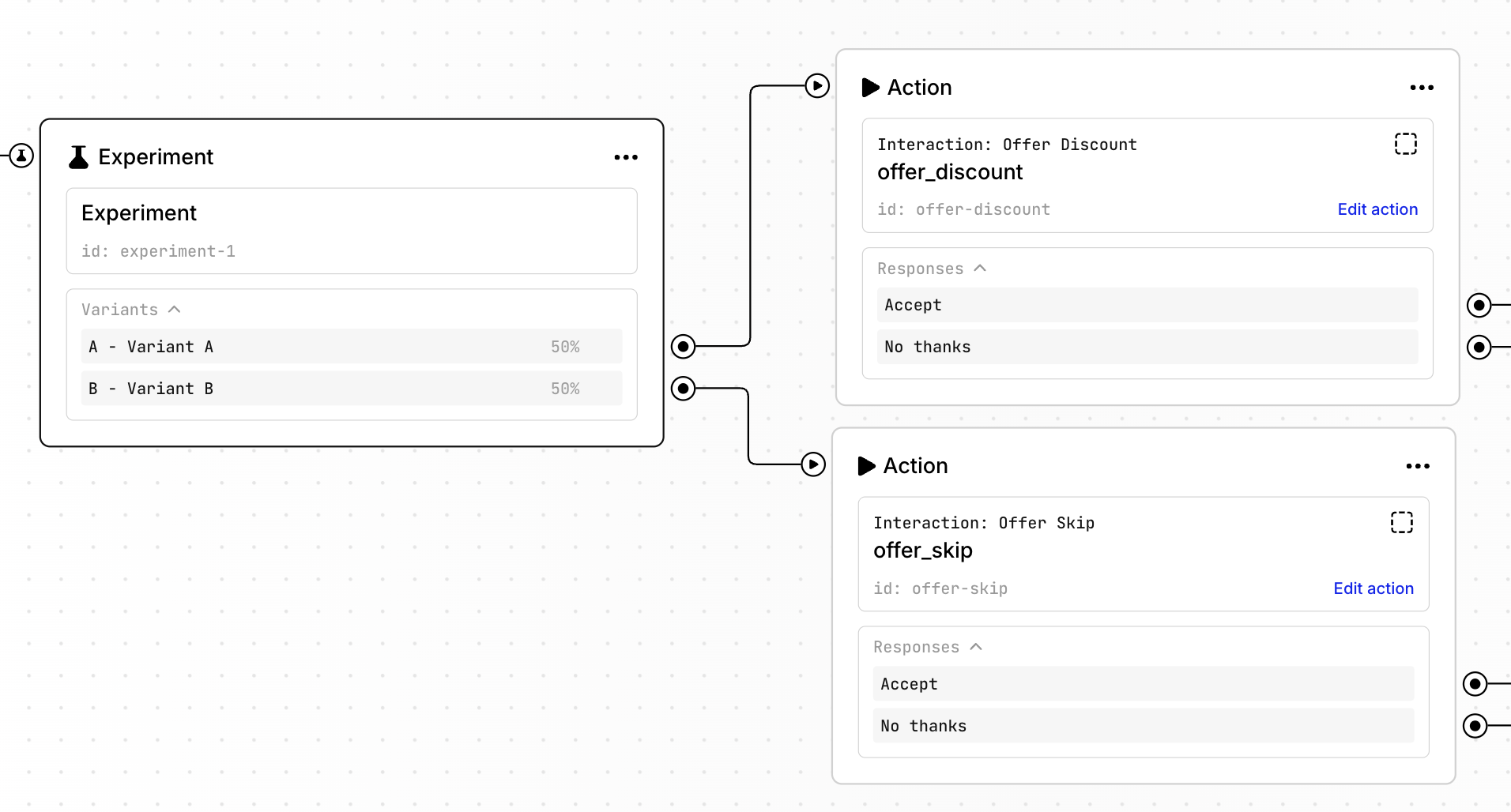
Experiments let you compare two or more versions of a workflow path and see which one performs better for your business goal (e.g. reduce cancellations, increase renewals, recover failed payments).
An experiment is a split step: it routes each customer into exactly one branch (Variant A, Variant B, …) based on your chosen traffic split.
How to create an A/B test
In Admin Panel → Workflows:
- Create or open a workflow (start from a trigger).
- Add an Experiment (A/B test) step where you want the split to happen.
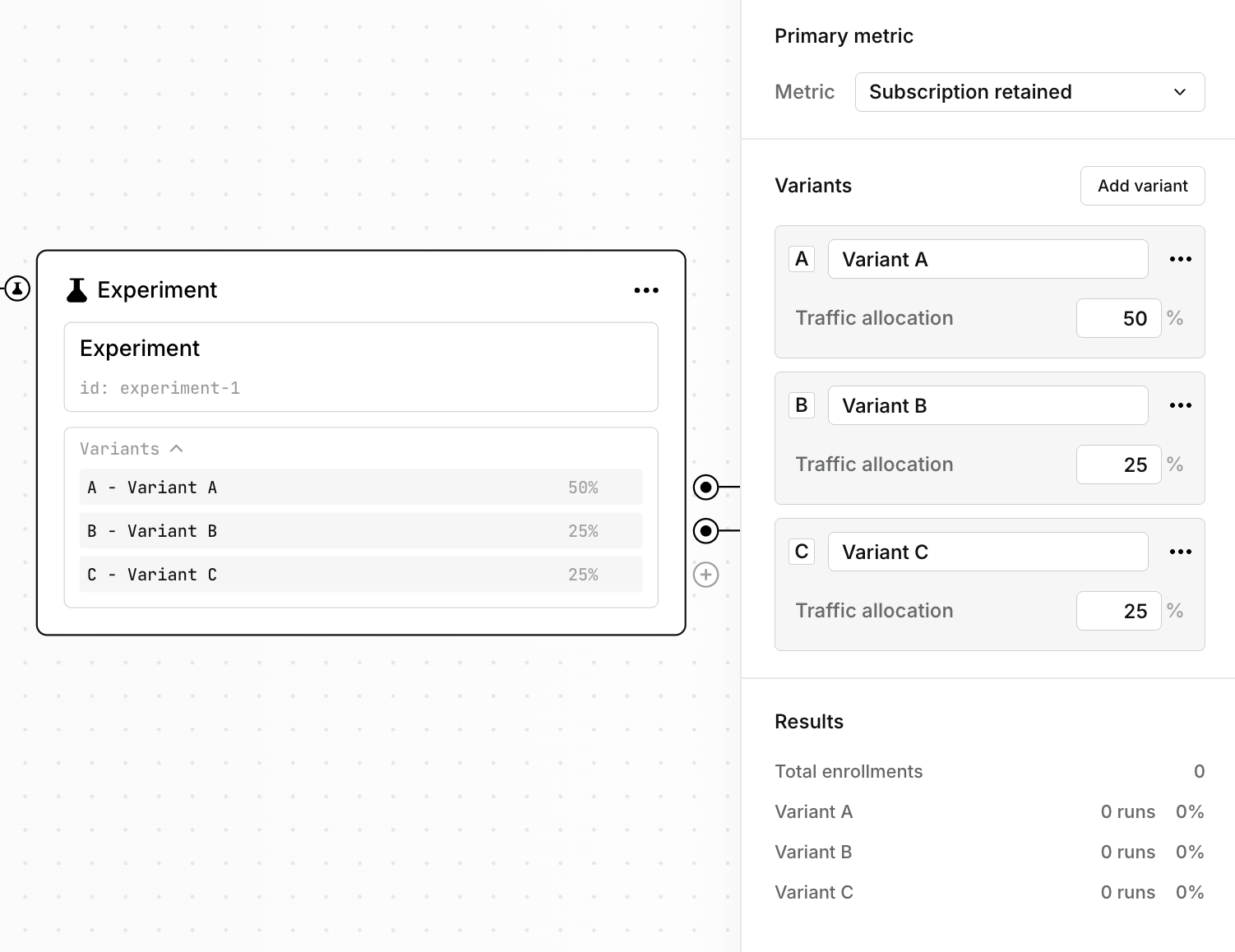
- Create 2+ variants (A/B/C…) and name them clearly (e.g. “Discount 10%”, “Offer pause”).
- Set a traffic split (typically 50/50 for A/B).
- Connect each variant branch to the actions/conditions you want that variant to run.
- Save and publish.
Variants persistence
- Within a single customer session / run: once a customer is assigned a variant, they stay in that variant while they move through the workflow (even if the run pauses and resumes later).
- Across separate runs (e.g. the same customer enters the workflow on another day): variant assignment may not be guaranteed to stay the same.
Reading results
In the Experiment panel you will see:
- Enrollments: how many customers entered the experiment step per variant
- Conversion rate (if shown for your workflow): success rate per variant
Choosing a good traffic split
- 50/50 is the default for A/B tests and gives the fastest learning.
- Use 90/10 only when you’re rolling out a risky change and want a smaller exposure.
- The editor will automatically adjust variant traffic so it sums to 100%.
When to use an experiment
Use experiments when you have a clear question like:
- Does offering 10% off retain more subscribers than offering skip?
- Is it better to show free product vs discount at step 1?
- Does changing the copy or button labels increase acceptance?
Avoid experiments when:
- You’re still unsure what problem you’re solving (start with a single workflow and iterate).
- You can’t measure success (no clear outcome / metric).
- You’re planning many changes at once (hard to interpret results).
Make sure each variant branch ends up doing something meaningfully different (offer, copy, timing, channel, etc.).